
Your needs, this model
Does it fit your priorities?
Does the Sixer Mips satisfy a Spherical/Mips requirement?
Not on the evidence reviewed. Bell names Mips Evolve for the exact Sixer style-069 page, while its separate Spherical models carry the Spherical Technology description. The finder’s Spherical/Mips requirement is narrower than a general Mips label; this distinction is not a safety ranking or crash result.
Explore this need in the finder →Which printed Sixer Mips size band contains a 63 cm measurement?
Bell’s exact chart lists L at 58–62 cm and XL at 61–65 cm, so 63 cm appears only in the XL row; the observed SKU is L. This identifies a chart candidate, not a personal size recommendation. Bell advises measuring level above the eyebrows and repeating the measurement; try the exact helmet and check stability, pressure and retention.
Explore this need in the finder →Does Bell’s CPSC statement establish a downhill-specific rating for the Sixer?
No separate ASTM F1952 downhill statement appears on the captured style-069 US product page. It does state CPSC compliance for persons age five and older. Bell’s separate general bicycle-helmet manual cautions that some helmet types may not suit extreme riding such as jumping or high-speed events; it is not specific to the Sixer. Check the exact helmet label and applicable riding rules rather than inferring a downhill rating from the MTB category or trail wording.
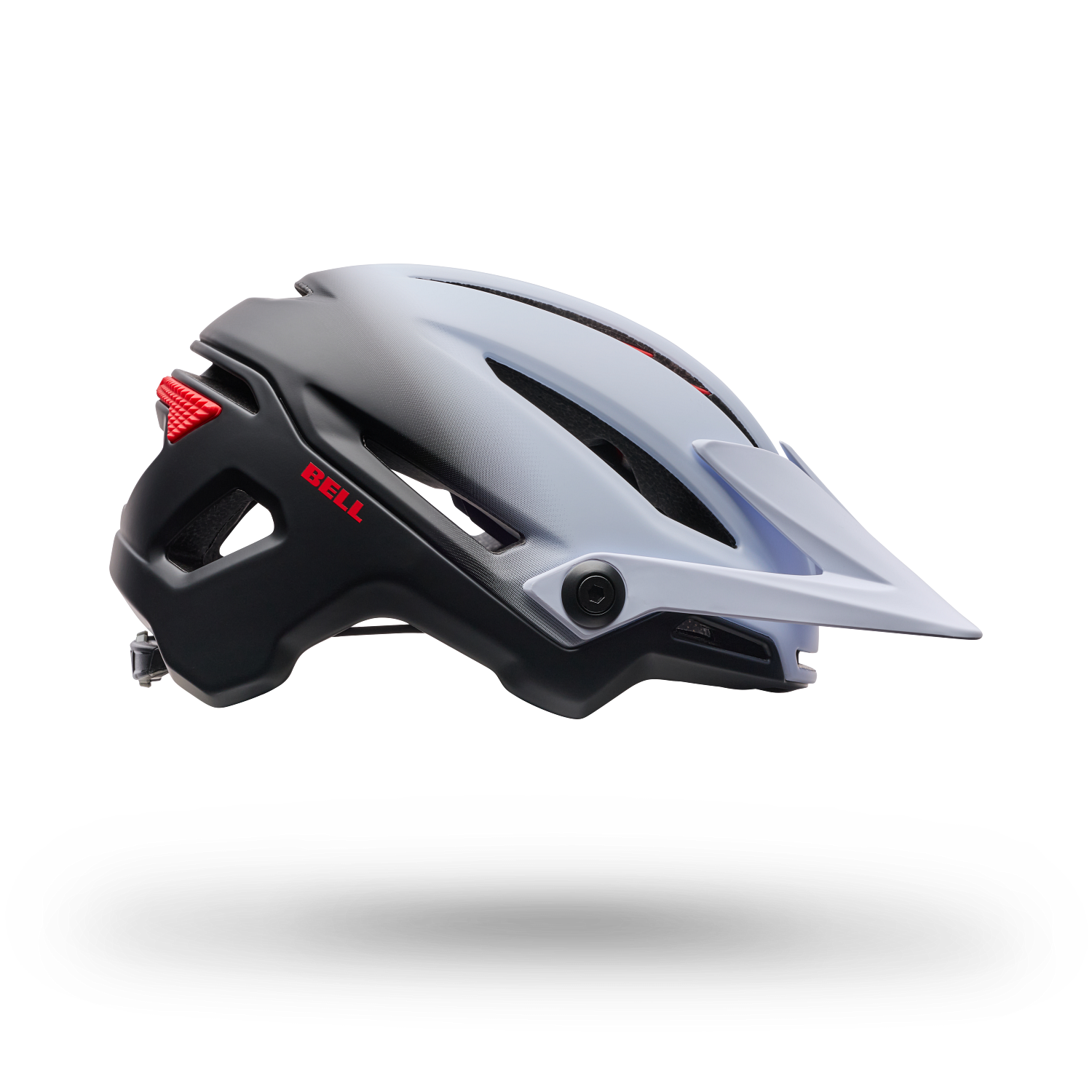
Explore this need in the finder →This is a source-based assessment of Bell’s US Sixer Mips, not a ride, fitting session, weighing or impact test. Bell’s MTB listing and exact style-069 page identify the observed version as White/Black, size L, SKU BL-7204035. The page places the model in its bike line and describes it as a trail helmet. Its name, image and listed features point to a conventional open-face design; this is not the separate removable-bar Super Air R or Super DH package.
A trail half-shell with an adjustment-focused feature set
Bell names Float Fit Race as the retention system and describes three adjustments: height, pad width and tension. That is useful information for someone comparing fit hardware, but it does not reveal what shape of head the shell suits or how much movement the mechanism provides. Nor can it tell whether this observed L will sit level and stay in place on a particular rider. A chart and an adjuster are screening tools, not substitutes for trying on the exact size and checking retention as the manufacturer instructs.
The page also lists a four-position visor, a rear goggle gripper and a Sweat Guide pad intended to move moisture away from the brow and eyewear. Bell describes Dual Flow ventilation and a full hard shell, but gives no wind-tunnel vent count or independently measured cooling result in the material reviewed. The product page calls goggles compatible; that broad statement is not a fit check with a named goggle, prescription glasses or other eyewear. The Integrated Breakaway Camera/Light Mount is a mount feature, not evidence that a camera or lamp is included or that every accessory fits it. Check the exact kit and accessory instructions before buying parts.
Mips Evolve is not Spherical/Mips
Bell names Mips Evolve on the exact Sixer page and explains it as a slip-plane design integrated with the retention system. That manufacturer description is not a measured injury reduction for this model, and a Mips name is not enough to satisfy every narrower design preference. The Sixer is not described as Spherical Technology powered by Mips. Bell’s separate 5Fifty Spherical uses that named architecture and has its own size and certification record; the features should not be carried across just because both helmets are from Bell’s MTB line. The earlier Super Air R Spherical is also a different, removable-bar package.
Read four size bands, not a single 52–65 cm fit promise
The exact style-069 page embeds Bell’s model-specific chart: S 52–56 cm, M 55–59 cm, L 58–62 cm and XL 61–65 cm. The bands overlap at 55–56, 58–59 and 61–62 cm. At 63 cm, for example, only the printed XL band remains; that is chart coverage, not a recommendation that the XL is the right size. The observed product is the L configuration, whose chart row ends at 62 cm. Do not let a result for the model obscure the size-specific SKU.
Bell’s measuring guidance is to use a soft tape above the eyebrows, keep it level and snug, measure twice and use the larger reading. Bell also advises sizing up if between bands. That guidance still cannot resolve head shape, pressure, stability, eyewear clearance or whether a helmet remains correctly positioned when you move. Test the actual helmet with the retention system set according to its instructions. If you are between bands, compare neighboring sizes rather than treating overlap as room to stretch a chart boundary.
What the standards and manual do—and do not—establish
The exact US page states compliance with the CPSC bicycle-helmet standard for persons age five and older, and lists 395 g for size M. The observed SKU is L, so the mass is Bell’s M-size figure, not a measurement of the helmet in this assessment. The page does not list an ASTM F1952 downhill statement. Its age-five-plus CPSC wording also does not make it a youth-specific model or establish a child’s fit.
Bell’s general bicycle-helmet manual is not labeled as a Sixer-specific manual, but it cautions that some helmet types may not suit extreme riding such as jumping or high-speed events. That caveat matters alongside the trail marketing: neither an MTB category nor the words “premium trail” answer whether this half-shell is appropriate for a particular downhill course, event rule or risk profile. If downhill use or an additional standard is essential, check the physical label and the exact model’s current instructions; do not infer a certification the captured page does not state. Bell’s manual also emphasizes proper fit and replacement after a severe impact, but this article does not inspect any individual unit.
Compare the package, not just the logo
For a rider who wants an open-face trail model with an adjustable retention system, a visor, a goggle strap feature and an integrated camera/light mount, the Sixer’s documented feature list is concrete enough to compare. Its main limitation is that the evidence here does not settle personal fit, downhill-specific certification, specific accessory compatibility or performance under impact. The 395 g number is manufacturer-reported for M, not a basis for comparing the observed L to another size.
Before considering an offer, check that it is Sixer Mips style 100000000500000069, White/Black, and the size/SKU you intend to try—not a visor, pad kit, camera mount or screw set displayed beside it. Inspect the label, shell, straps, fit system and included parts; ask about condition and return terms if it is not new, and review current recall information. The manufacturer’s dated model-name recall screen is not individual-unit clearance. A fit-chart match, Mips label or CPSC statement cannot promise protection or prove that a seller’s unit is authentic or undamaged.
Key specifications
Key details at a glance
| Helmet style | Half-shell |
|---|---|
| Documented removable chin bar compatibility | No |
| Chin bar included with observed model package | No |
| Listed fit sizes | S / M / L / XL |
| Published circumference floor | 52 cm |
| Published circumference ceiling | 65 cm |
| US CPSC compliance stated | Yes |
| Rotational-impact design | Mips Evolve |
| Fit adjuster | Float Fit Race |
| Fit adjustments described | Bell describes Float Fit Race as integrated with Mips and adjustable in height, pad width and tension; no personal fit, adjustment travel or head-shape result was measured. / The exact inline style-069 chart publishes separate S, M, L and XL circumference bands. Adjacent bands overlap, so the chart can return more than one candidate size and cannot select an individual fit. |
| Manufacturer-stated Medium weight | 395 g |
Use the exact model’s instructions for operating limits, supplied equipment and version differences.
Sources for this review
Sources for this assessment
- Bell US MTB category card for Sixer Mips style 100000000500000069, White/Black / L, SKU BL-7204035
- Bell exact US Sixer Mips style 100000000500000069 page and inline model-specific chart; White/Black / L, SKU BL-7204035
- Bell exact US style-069 White/Black route rechecked for product identity and dated page presentation
- Bell US helmet size chart and measuring guide, used for measurement method; the Sixer rows are from its exact product page
- Bell Bicycle Helmet Owner’s Manual, Part B5000433-F; general bicycle-helmet guidance, not a Sixer-specific manual
- Bell US helmet recall notice; dated model-name screen checked against the Sixer Mips observation
- CPSC Bell Sports 2025 bicycle-helmet recall notice, affected models and styles
- Bell manufacturer image shown on the exact US style-069 White/Black route
Compare the model with your own constraints
A model assessment cannot decide fit by itself. Use the finder to combine riding use, head circumference and documented features, then verify the exact helmet and instructions.