
Your needs, this model
Does it fit your priorities?
What is the documented use and coverage format of Full-Air Mips?
Bell lists Full-Air Mips in its MTB range, calls it a full-face helmet, and describes pedaling uphill and descending; the exact US page also names ASTM F1952-15 Downhill. Its cheek-pad system and temple pads are removable, but Bell does not say the chinbar detaches. Match the helmet and its label to the actual discipline rather than assuming every removable pad changes the helmet category.
Explore this need in the finder →Does Full-Air Mips meet a Spherical/Mips request?
No. The US product page names Mips Evolve, not Bell Spherical Technology, so this documented design does not meet the finder’s narrower Spherical/Mips requirement. A technology label describes a design, not a personal injury guarantee.
Explore this need in the finder →Which circumference bands does Bell publish for this model?
The Bell size chart lists S at 51–55 cm, M at 55–57 cm, L at 57–60 cm and XL at 60–63 cm. Its L imperial endpoints conflict with the metric figures, so verify the live chart and exact size before choosing; circumference is a screening measure, not a fit result.
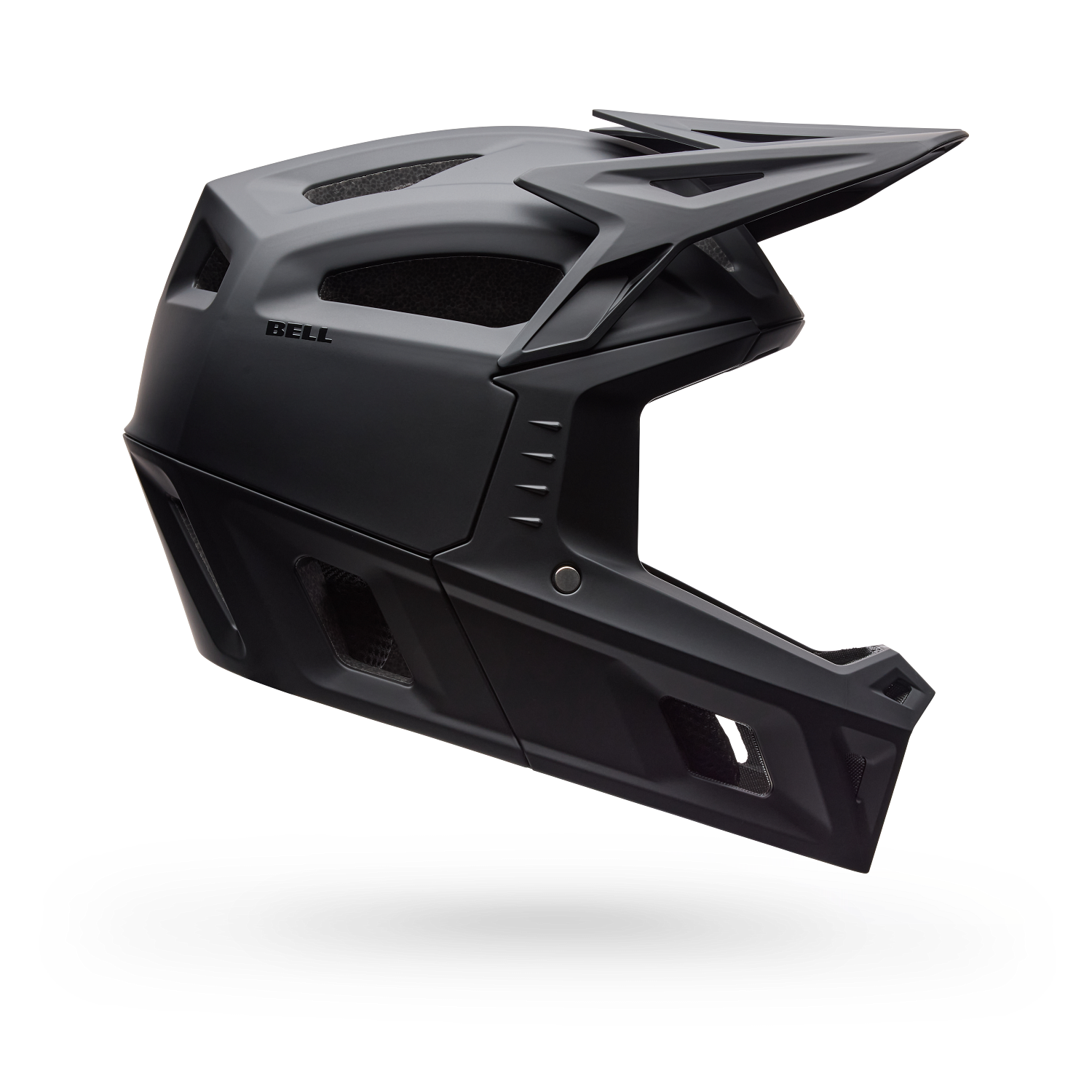
Explore this need in the finder →Bell's Full-Air Mips is a full-face helmet in the brand's US mountain-bike catalogue, not a half-shell with an interchangeable chinbar. The observed style is 100000001500000026 in Matte Black / L, SKU BL-7203665. Bell's exact US page presents it for climbing and descending, names several standards, and lists a mixture of ventilation, visor, pad and camera/light-mount features. This is a document-based assessment: I have not ridden, fitted, weighed or crash-tested the helmet.
A full-face format with removable pads
The distinction that matters first is the shell. Bell calls this a true full-face helmet. Its page says cheek-pad sections can be removed to increase airflow or added for more security, and it separately lists removable temple pads. Those statements describe pad changes; they do not say the chinbar detaches. A shopper seeking a helmet that converts to an open-face mode should not read “modular cheek pad system” as evidence of a removable chinbar.
Bell's catalog places the model in MTB, while its description talks about pedaling to the top and descending. The exact page lists ASTM F1952-15 Downhill and ASTM F2032-15 BMX, alongside US CPSC, NTA 8776 (E-Bike), CE EN 1078-2012 and AS/NZ 2063. This is a list from Bell, not a laboratory result produced for this assessment. The page doesn't give an age-specific CPSC statement, so I don't import age wording from other Bell models. Confirm the markings on the actual helmet and follow the instructions that come with that exact unit. Bell's general manual cautions that some helmets may not suit extreme riding and says the inside label identifies intended use; the Full-Air page's downhill language is a model-specific detail to compare against that label, not a reason to ignore it.
Four chart bands, one important discrepancy
Bell's US size-chart data lists S at 51–55 cm, M at 55–57 cm, L at 57–60 cm and XL at 60–63 cm. The neighboring bands meet at 55, 57 and 60 cm, so a number at a seam can appear in two sizes. A chart is a screening aid for selecting sizes to try, not proof that a particular shape, pressure pattern or retention adjustment will work for a particular head.
There is a source conflict in the L row: the chart's metric cell says 57–60 cm, but its imperial cell says 21 3/8–23 1/2 inches. Those endpoints do not agree when converted. Because the finder asks for centimeters, its L plan follows the displayed centimeter interval, while this review flags the mismatch instead of silently reconciling it. Check the current chart, selector and physical size marking before choosing L. Bell's linked instructions say to measure level above the eyebrows, repeat the measurement and use the larger reading; the page also advises sizing up when directly between sizes. Try the helmet on and check position, straps and retention as the manual directs.
Useful hardware—and claims with no measurement behind them
The listed equipment is specific: Advanced Mips Evolve, dual-density EPS, an in-mold polycarbonate shell, a two-position Flying Bridge visor intended for eyewear or goggle storage, a removable washable liner, Sweat Guide padding, a Fidlock magnetic buckle, removable temple pads and a breakaway under-visor action-camera/light mount. Bell says the cheek-pad system can be configured for more airflow or security. The page does not name a numeric vent count, provide an airflow or cooling measurement, specify a head-shape profile, or identify a dial-based fit system. It also provides no weight figure on the exact US page. “Lightweight” and “superior ventilation” are manufacturer descriptions, not measurements I can verify here.
Mips Evolve is the system the page names. It is not Bell's Spherical Technology, so the model does not satisfy a finder choice that specifically requires Spherical/Mips. That distinction can matter when comparing Full-Air with a documented Spherical full-face such as the Giro Coalition Spherical style 027; that Giro page's review explains a different rotational design and a separate US-CPSC evidence gap. Neither system label is a personal protection guarantee, and the two model pages are not comparative crash tests.
Who should put it on a try-on list?
It is a reasonable research candidate if you want a full-face mountain-bike format, the exact Bell page's US CPSC statement, Mips Evolve, and the published size bands—and if you can verify the chart discrepancy and the fit in person. The visor storage, Fidlock buckle, washable liner and under-visor mount are practical details to check against your eyewear, camera/light and care routine. Before treating the accessory mount or cheek-pad options as a reason to buy, confirm which pieces are actually included in the exact offer: Bell cross-lists replacement cheek pads and a visor, and those separate accessories are not proof of package contents.
Look elsewhere if your must-have is an open-face helmet, a documented Spherical/Mips system, a stated numeric weight, a confirmed adjustable fit mechanism, or an unambiguous L-size chart. The US page doesn't establish those needs. Bell's recall page checked for this assessment names other helmet families, not Full-Air Mips; the CPSC bicycle-helmet recall-category request available to this research returned HTTP 403. That dated manufacturer-page screen is not a unit-history clearance or a promise that no later notice exists.
Primary material reviewed
- Bell's exact US Full-Air Mips style page and its linked US helmet size-chart library.
- Bell Bicycle Helmet Owner's Manual for general measurement, use-label and fit-check guidance.
- Bell's US recall notice, checked 2026-11-01. The category-level CPSC page was inaccessible in the preserved 2026-10-31 request, so no agency recall clearance is claimed.
This review reports source documents rather than personal use, independent testing, crash performance, customer sentiment, stock or a current price.
Key specifications
Key details at a glance
| Helmet style | Full-face MTB helmet |
|---|---|
| Listed fit sizes | S / M / L / XL |
| Published circumference floor | 51 cm |
| Published circumference ceiling | 63 cm |
| US CPSC compliance stated | Yes |
| Rotational-impact design | Mips Evolve |
| Fit adjustments described |
Use the exact model’s instructions for operating limits, supplied equipment and version differences.
Sources for this review
Sources for this assessment
- Bell US MTB helmet directory, observed Full-Air Mips style 100000001500000026 card
- Bell Full-Air Mips exact US style 100000001500000026, observed Matte Black / L variant
- Bell US helmet size-chart library, including the Full-Air Mips chart
- Bell Bicycle Helmet Owner's Manual, Part B5000433-F
- Bell Sports US helmet recall notice, date-bounded model-name screen
- CPSC bicycle-helmet recall category response; HTTP 403, not treated as inspected recall data
Compare the model with your own constraints
A model assessment cannot decide fit by itself. Use the finder to combine riding use, head circumference and documented features, then verify the exact helmet and instructions.