
Your needs, this model
Does it fit your priorities?
Can a measured circumference select a Prevail 3 size in this review?
Not from the saved US evidence: the page shows S, M and L, while the displayed Size Guide control did not expose an exact circumference chart in the captured source. The finder therefore leaves numeric endpoints unknown. Use the live exact-model chart and try the selected size on; letter sizes and dial travel are not substitutes for a chart or fit check.
Explore this need in the finder →Does the exact US Prevail 3 page document CPSC compliance?
Yes. Specialized says helmets sold in the US and Canada comply with the US CPSC bicycle-helmet standard for people age five and older. Check the physical label and exact edition; standards compliance is not a promise against injury.
Explore this need in the finder →Does Mips Node Air meet a Spherical/Mips requirement?
No. The exact page calls the system Mips Node Air, integrated into the padding; it does not identify Giro Spherical Technology powered by Mips. The finder keeps those labels distinct, so a Spherical must-have excludes this otherwise road- and CPSC-documented option.
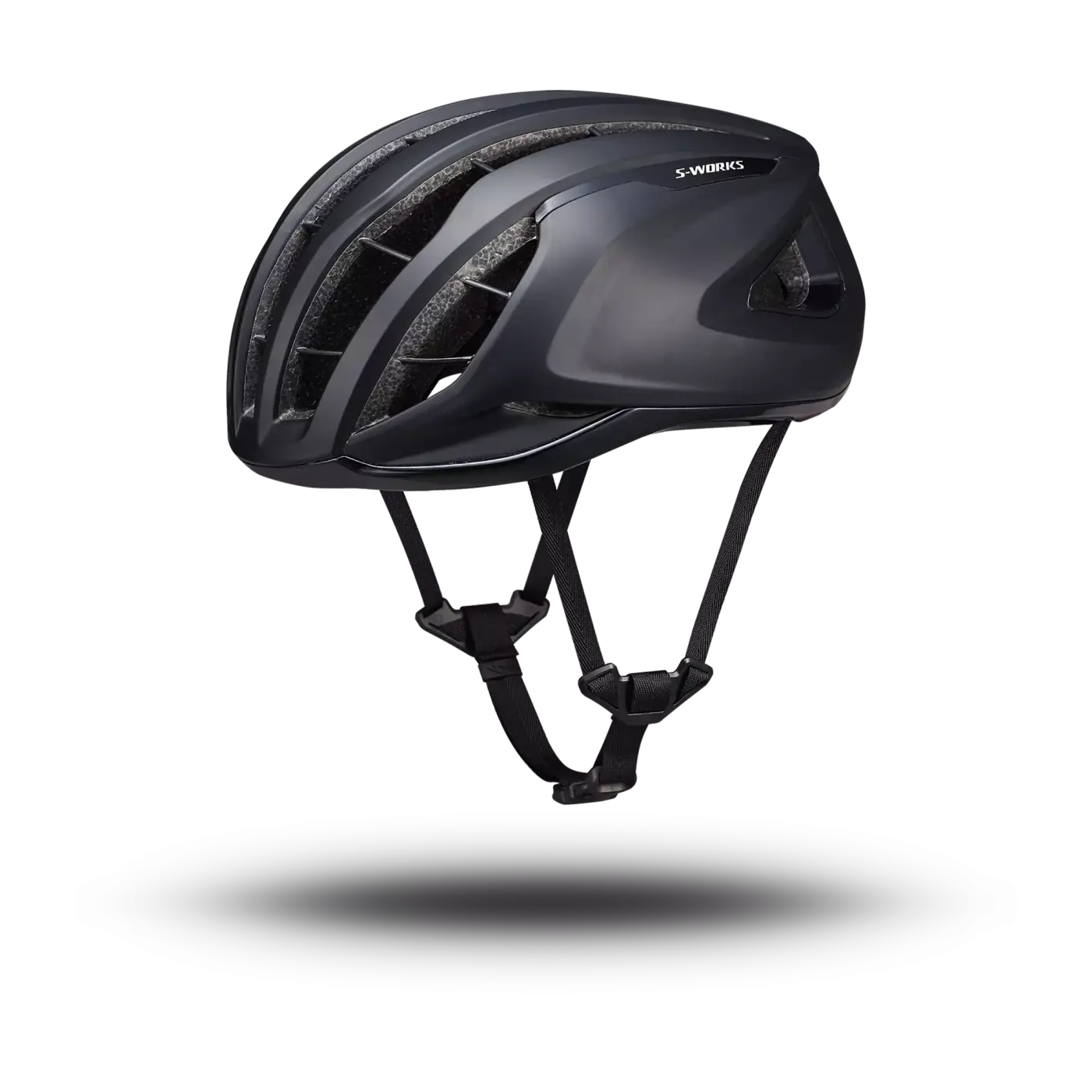
Explore this need in the finder →The Specialized S-Works Prevail 3 is an adult road-category half-shell aimed at riders who put ventilation high on their list. Its Black US page offers S, M and L, identifies Mips Node Air, and explicitly says the US/Canada version complies with the CPSC bicycle-helmet standard for people age five and older. This is a document-based assessment of that exact page, not a fit session, cooling test, wind-tunnel trial or crash evaluation by this site.
AirCage and ventilation are the main reasons to consider it
Specialized describes the Prevail 3 as its most ventilated helmet and says the ventilation surface area is 24.5% greater than the S-Works Prevail II Vent. Its explanation is specific: the company removed central foam bridges to create through-air channels, while woven aramid fibers cross the helmet and anchor at carbon-fiber side panels. Specialized describes those fibers as part of the AirCage structure intended to distribute localized impact force while leaving room for more ventilation. These are meaningful design details, but the 24.5% comparison and energy-management claims remain manufacturer statements; the public page does not supply a test protocol that would let this review independently verify them or predict comfort for a particular rider.
The fit hardware also gets more than one mention. A Mindset micro-dial is described as height-adjustable, and the Occipital Base Adjustment is intended to let a rider set the retention cradle's position and helmet angle. Tri-Fix webbing uses 10 mm straps, which Specialized says can reduce strap noise. Those controls are relevant if a shopper wants to fine-tune a road helmet, but a list of adjustment mechanisms does not establish that the internal shape suits every head. The page lists three letter sizes without an exposed circumference chart in the captured source, so this assessment deliberately declines to map a tape measurement to a Prevail 3 size.
Do not confuse its Mips label with Spherical
The product page names Mips Node Air integrated into the padding. The finder stores that system as Mips Air Node, not as Giro's Spherical Technology powered by Mips. Those names should not be treated as interchangeable just because each refers to rotational-impact design. A shopper who specifically requires Spherical should use that filter and compare the actual results rather than broadening the term to any helmet carrying a Mips name. Conversely, a road rider who does not require that exact construction can still compare the Prevail 3 on its documented road category, adjustment features and verified standard statement.
Fit and CPSC evidence answer different questions
Specialized's explicit US CPSC statement is stronger evidence than a CPSC-labelled weight line alone, and the finder can therefore include the Prevail 3 when documented compliance is essential. It is still a standard, not a promise that a helmet prevents every injury or suits every crash condition. Before choosing an offer, confirm the exact US model and inspect the permanent label on the unit you receive. The captured page also says the product no longer supports ANGi, so a rider seeking that sensor should not assume an earlier Prevail feature carries over.
For sizing, the saved product page exposed a Size Guide control but not the chart's centimeter values. The general Specialized Size Guides landing page likewise returned no individual helmet table in this capture. The retailer page lists S/M/L; it does not identify which head circumference each size covers. The numeric finder therefore excludes this model whenever a measured circumference is required. That conservative result means only that this evidence set lacks an exact range. Check Specialized's current chart, try the helmet on, and confirm that it sits level and secure without painful pressure before riding.
Where it fits in a road comparison
The Prevail 3 and Specialized's S-Works TT 5 both sit under Road Bike Helmets and both name Mips Node Air, but they answer different design priorities. The Prevail 3 presents a highly open ventilation layout for road climbs and hot conditions; the TT 5 is shaped around a time-trial position and includes an optical shield. That distinction is more useful than guessing which is "faster" or "cooler" from marketing claims. A product page can describe engineering intent, but neither shell becomes the right answer without confirming event rules, size, eyewear preferences and real fit.
Consider the Prevail 3 if the manufacturer-documented road use, AirCage construction, ventilation channels and adjustable retention are relevant to the riding you actually do, and if you can establish the correct size from the current chart and a try-on. It is not a numeric-chart match in this saved library, and it does not satisfy a Spherical/Mips must-have. Those are evidence boundaries, not a verdict against the helmet.
Key specifications
Key details at a glance
| Helmet style | Half-shell |
|---|---|
| Listed fit sizes | S / M / L |
| US CPSC compliance stated | Yes |
| Rotational-impact design | Mips Air Node |
| Fit adjuster | Mindset micro-dial with height adjustment; Occipital Base Adjustment |
| Fit adjustments described | Mindset micro-dial tension adjustment / height-adjustable retention system / Occipital Base Adjustment changes position for head shape and helmet angle / Tri-Fix webbing with 10 mm straps |
| Eye shield described | No |
Use the exact model’s instructions for operating limits, supplied equipment and version differences.
Sources for this review
Sources for this assessment
Compare the model with your own constraints
A model assessment cannot decide fit by itself. Use the finder to combine riding use, head circumference and documented features, then verify the exact helmet and instructions.