
Your needs, this model
Does it fit your priorities?
Will the Evade 3 appear when the finder is set to current models only?
No. The observed Specialized catalogue also lists the later S-Works Evade 4 as a separate product family. This review treats Evade 3 as an earlier generation, so it is excluded by current-only and included only when earlier models are allowed; this does not imply anything about present stock.
Explore this need in the finder →What documented road conditions does the earlier Evade 3 satisfy?
With earlier models included, its exact Black US page supports road use and an explicit age-five-plus CPSC statement. It uses Mips Air Node, not Spherical/Mips; the CPSC claim is not a guarantee about injury or the label on an individual unit.
Explore this need in the finder →Can a 57 cm measurement pass the Evade 3 numerical filter?
Not in this evidence record. The exact page offers S/M/L but the saved page and linked size-guide landing do not give circumference endpoints. The numeric matcher therefore excludes it at 57 cm even when earlier models are allowed.
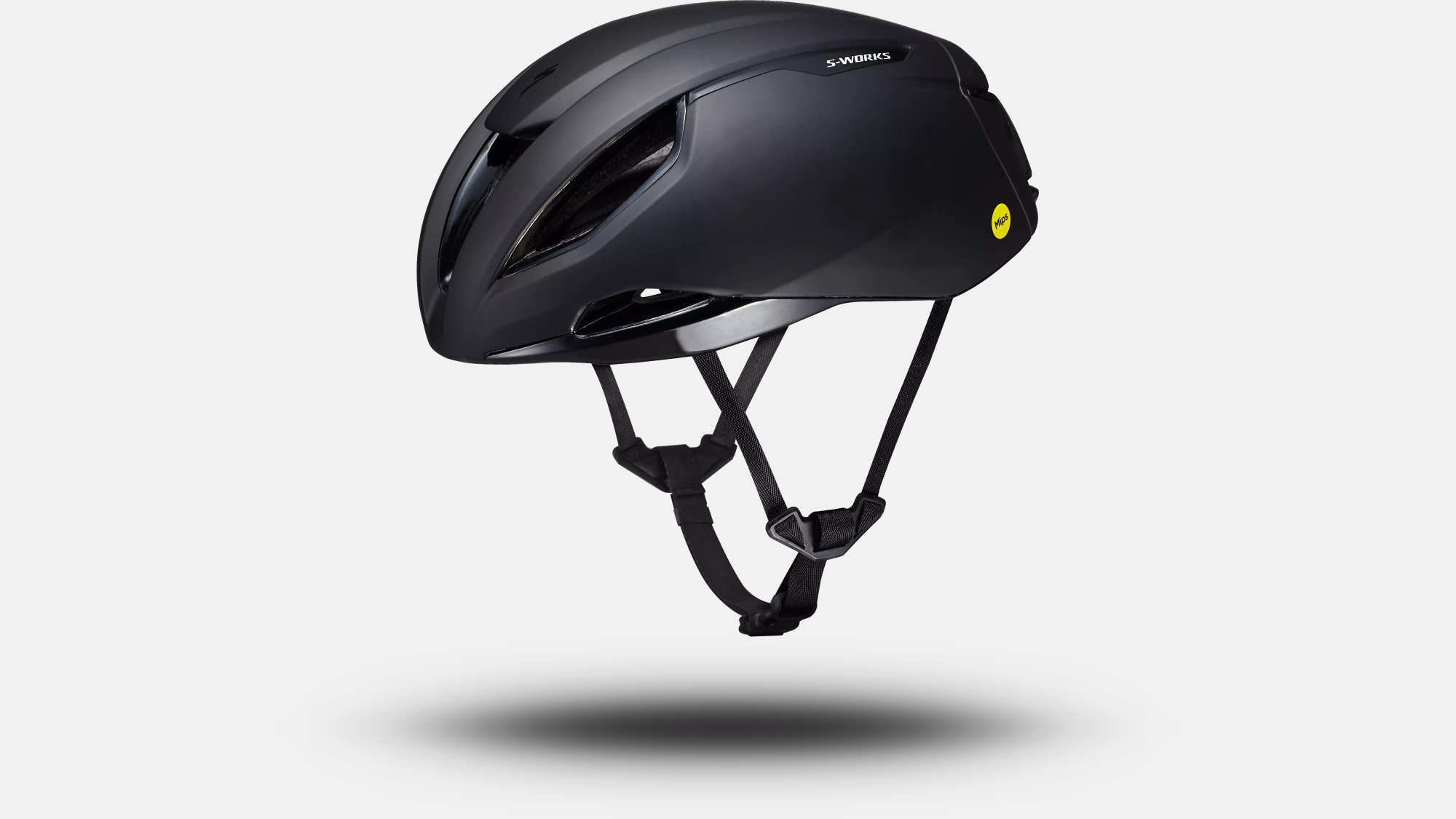
Explore this need in the finder →The S-Works Evade 3 is an aero road half-shell from the generation before the separately listed Evade 4. The exact Black US product page categorizes it under Road Bike Helmets and identifies Mips Air Node, a rear diffuser, an Occipital Base Adjustment, adjustable angle and US CPSC compliance. It offers S, M and L, but the saved page and linked size-guide capture do not bridge those labels to circumference. This is a source-based review: no one at this site wore, measured, rode or wind-tunnel-tested the helmet.
Keep the Evade generation clear
The Specialized US helmet directory lists S-Works Evade 3 and S-Works Evade 4 as separate entries with different product-family IDs. This assessment keeps Evade 3 as an earlier generation, rather than merging its specifications into the newer model. “Earlier” describes the model relationship, not current stock, condition or availability. When reviewing a seller offer, check the exact suffix and product code: a photo, title or partial search phrase can easily blur two generations together.
The exact Evade 3 page calls it a road helmet and describes an aero road design. That supports the road choice in this library; the broader idea that a road helmet could physically be worn on a gravel path is not enough to add a separate gravel-use tag. No urban, trail or child plan is inferred. The distinction keeps finder answers close to what the manufacturer's page actually documents.
Airflow claims need their measurement context
Specialized describes larger front vents, internal channels and a rear diffuser. It says the diffuser helps improve ventilation and draws 10 percent more air through the helmet at a given speed, based on its CFD and Win Tunnel development. That is a manufacturer test claim with a stated comparison context, not a result independently reproduced by this review. It should not be read as a guarantee of comfort or cooling for an individual rider.
The diffuser is presented as an aerodynamic and airflow feature, not a separate speed promise. The practical question is whether this style suits the riding task and works with the rider's fit, eyewear and position. A product page's claim about air movement cannot determine that from a desk. Compare the version you are considering with its instructions and try it on in the intended position.
Adjustment and Mips Air Node
The page names an Occipital Base Adjustment and adjustable helmet angle, including a note about compatibility with glasses. It also lists a Tri-Fix web splitter with thinner 10 mm webbing. These give a shopper several concrete setup details to examine: how the rear adjustment sits, whether the helmet can be positioned as directed, whether the straps route correctly and whether eyewear remains comfortable. They do not establish that the shell's underlying shape will suit every head.
Specialized calls its rotational system Mips Air Node and describes the low-friction layer as integrated into the padding. This is not the specifically named Spherical Technology powered by Mips architecture used by the Spherical finder choice. The distinction is not a safety ranking; it is a check against the exact feature a visitor selected. The page also states CPSC compliance for helmets sold in the US and Canada for people five and older, so it can satisfy a documented CPSC screen while still failing a Spherical/Mips must-have.
Size and support gaps
The captured page offers S/M/L but does not show model-specific circumference endpoints. The linked US Size Guides page returned a shell without a usable Evade 3 chart. This review therefore cannot say that a measured 57 cm head—or any other measurement—falls within the documented range. The numeric finder leaves the product out at every measurement until a model-specific chart is verified. Letter sizes, strap adjustment and an eyewear note are not valid substitutes for a circumference interval or an individual try-on.
Specialized says this generation no longer supports ANGi. Check the actual product instructions and seller details before assuming any sensor service is available. Its support status is another reason to identify the generation precisely, not to attribute a sensor or feature from a newer or older model. The page's US CPSC wording should also be checked against the marking on the helmet being offered.
Who should compare the earlier Evade 3?
It remains relevant to shoppers comparing an earlier aero road design with documented Mips Air Node and CPSC statements. It appears only when the finder includes earlier models. If the requirement is current models only, the Evade 3 is intentionally excluded even though its product page remains accessible; that lifecycle choice does not say whether a retailer has stock.
Before considering an exact offer, verify that it is Evade 3 rather than Evade 4, check its label and safety notices, find the chart for its exact generation, and try the intended size with the eyewear and straps in use. The 10 percent airflow claim is worth noting as Specialized's stated result, but it is not this site's test. The useful comparison is its documented design and limits—not an unverified claim that it is faster, cooler, safer or a guaranteed personal fit.
Key specifications
Key details at a glance
| Helmet style | Half-shell |
|---|---|
| Listed fit sizes | S / M / L |
| US CPSC compliance stated | Yes |
| Rotational-impact design | Mips Air Node |
| Fit adjuster | Occipital Base Adjustment |
| Fit adjustments described | occipital-base fit adjustment / helmet-angle adjustment / adjustable Tri-Fix web splitter with 10 mm webbing |
| Eye shield described | No |
Use the exact model’s instructions for operating limits, supplied equipment and version differences.
Sources for this review
Sources for this assessment
Compare the model with your own constraints
A model assessment cannot decide fit by itself. Use the finder to combine riding use, head circumference and documented features, then verify the exact helmet and instructions.