
Your needs, this model
Does it fit your priorities?
Does Source Mips belong in a trail-riding comparison?
Yes. Giro’s MTB collection calls the exact family an open-face MTB helmet and the product page describes a trail-ready design. That supports a trail category, not a claim about every discipline or a full-face configuration.
Explore this need in the finder →Is US CPSC compliance documented for this exact Source Mips style?
The captured exact page lists CE EN 1078 but no CPSC statement. The matcher therefore treats CPSC status as unknown and does not satisfy a required-CPSC choice; check the exact helmet marking and current documentation.
Explore this need in the finder →Is Source Mips a Spherical Technology model?
The exact page calls it integrated Mips but does not identify Spherical Technology powered by Mips. Those labels are not interchangeable in this guide, so Source does not pass the Spherical/Mips filter.
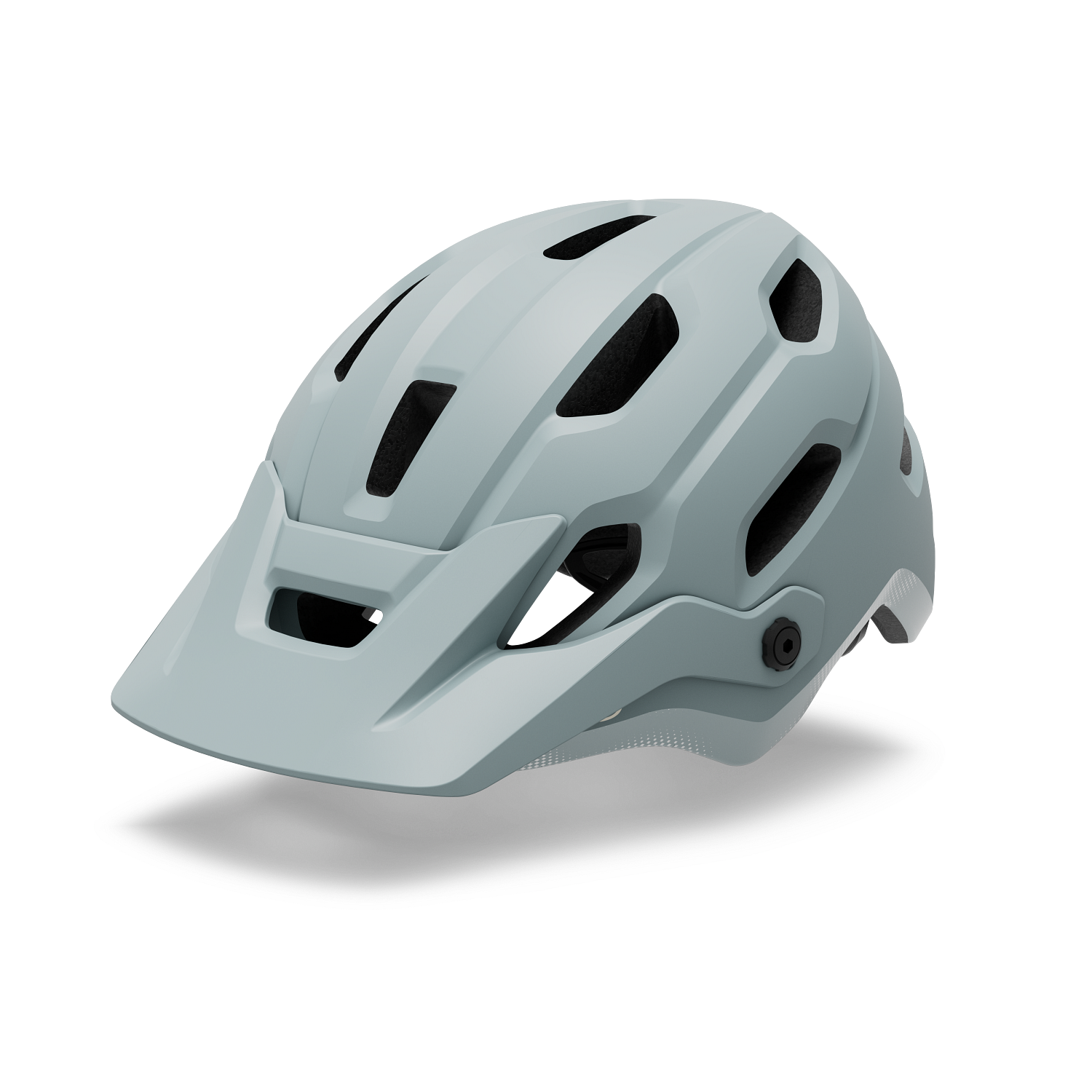
Explore this need in the finder →Source Mips is the most specification-rich of the three open-face trail models considered in this cycle: its exact Giro US page names 17 vents, deep internal channeling and an adjustable visor. This review is limited to US style 100000000500000098 and the observed Matte Sky Blue Pulse / M configuration, SKU GR-7202161. Giro describes Source as a rugged, trail-ready open-face MTB helmet. The assessment is based on that product record, not on a ride, fitting session or comparative cooling test.
Trail use, deep coverage and ventilation details
The manufacturer’s MTB collection explicitly calls Source an open-face MTB helmet and the product page describes a trail-ready design. The page says its shell has deep coverage and 17 vents paired with internal channels. That count is concrete evidence to compare with models whose pages use general ventilation language but give no number. It is not a test result: vent count alone does not prove that a helmet runs cooler, and no controlled airflow or temperature measurement is available here.
Giro describes the helmet as having a rugged construction and an in-mold Hardbody lower wrap. The lower shell extends protection of the foam liner according to the product copy; this should be read as a design description, not independent impact, abrasion or durability data. Source remains a half-shell. The page does not establish a full-face configuration, a particular downhill standard or suitability for every kind of mountain-bike use.
Adjustable visor and retention system
Source pairs a Roc Loc 5 Mips fit system with a moto-style visor that can be adjusted vertically. Giro describes the fit control as a one-hand way to tune tension and fore-aft tilt. The page also describes the visor as tool-free and bolt-on, with indexed positions intended to allow goggle storage above the brow. Before treating that as useful for your setup, try the exact helmet with your eyewear and inspect how the visor attaches; a source description does not guarantee compatibility with every goggle or accessory.
The exact US product page lists 340 g for size M. That is the manufacturer’s number for that size, not an independent weighing. Radix Mips is listed at 300 g in M and Artex Mips at 280 g in M, so Source has the highest published figure among these three. This comparison is only between the stated manufacturer numbers; it does not say how each will feel or perform on a rider.
Mips and certification should be checked separately
Giro identifies an integrated Mips brain-protection system on the exact page. It explains the design goal as reducing rotational forces in certain impacts while combining the Mips slip plane with the adjustable retention system. The page does not use the Spherical Technology powered by Mips designation. A general “Mips” label therefore does not meet this guide’s narrower Spherical/Mips preference, and neither designation predicts what will happen in a crash.
The certification panel lists CE EN 1078. The captured page does not state US CPSC compliance. The matcher leaves that field unknown and excludes Source when a visitor makes CPSC documentation essential; missing wording is not a finding that a physical helmet is non-compliant. Check the exact helmet marking and current manufacturer documentation, especially if the standard is a condition of purchase or use.
Size chart and fit boundaries
The product page offers S, M, L and XL. Giro’s general bicycle chart maps these adult options to 51–55 cm, 55–59 cm, 59–63 cm and 63–65 cm. The combined range helps locate possible sizes, but it does not establish head shape or successful fit. A measurement at a chart edge deserves particular care: measure level around the widest part of the head, use the instructions for the exact model and confirm that the helmet sits low enough, level and stable after adjustment. Do not compensate for poor fit by relying on a broader size label.
Compare the exact feature differences
Source’s strongest evidence-based distinction is its 17-vent count, deep coverage and adjustable moto-style visor. Radix Mips offers a P.O.V. visor with described indexed positions and is lighter by the manufacturer’s size-M figures, but its page supplies no count. Artex Mips lists Roc Loc 5 Air Mips, a removable visor and IonIC+ padding and is lighter on paper, yet its page also lacks a numeric vent count. Those differences can matter more than product names alone. None of the official copy supplies a direct measured cooling comparison, so it would be misleading to rank their ventilation performance.
Source is listed in Giro’s MTB collection alongside these options. The shared category does not make all three interchangeable: visor attachment, fit adjuster, vent documentation, size range and compliance wording differ. The standard should be checked on the exact unit, and any retailer listing needs to match US style 098, the intended size and desired finish rather than a similarly named edition.
Shortlist judgment
Consider Source if you ride mountain-bike trails, want an open-face shell with a documented 17 vents, deeper coverage and a vertically adjustable visor, and one of its S–XL sizes fits after a proper try-on. The tradeoffs are the page’s 340 g M figure, unknown individual fit, no Spherical designation and no captured CPSC statement. If CPSC evidence is essential, this source record is not enough. If exact vent documentation matters, Source is clearer on paper than Radix or Artex, but that is a specification distinction rather than proof of superior cooling. Confirm the exact model and package, inspect the physical label, verify visor parts and try on before relying on the size chart. This is a researched assessment, not a claim of personal testing.
Key specifications
Key details at a glance
| Helmet style | Half-shell |
|---|---|
| Listed fit sizes | S / M / L / XL |
| Published circumference floor | 51 cm |
| Published circumference ceiling | 65 cm |
| Rotational-impact design | Integrated Mips |
| Fit adjuster | Roc Loc 5 Mips |
| Fit adjustments described | one-hand tension adjustment / fore-aft tilt adjustment |
| Verified vent count | 17 vents |
| Manufacturer-stated Medium weight | 340 g |
Use the exact model’s instructions for operating limits, supplied equipment and version differences.
Sources for this review
Sources for this assessment
- Giro Source Mips, exact observed US style 100000000500000098 and Matte Sky Blue Pulse / M route
- Giro US MTB helmet category and product-use descriptions
- Giro US bicycle helmet size chart
- Giro US cycling helmet directory, original observed card
- Giro US recall notices checked for the observed model family
Compare the model with your own constraints
A model assessment cannot decide fit by itself. Use the finder to combine riding use, head circumference and documented features, then verify the exact helmet and instructions.