
Your needs, this model
Does it fit your priorities?
What use does Giro document for Quarter Mips style 030?
Giro describes this exact skate-style dirt helmet for riding trails or the skate park. That supports a trail comparison in this finder, but does not establish that it is full-face or intended for every mountain-bike discipline.
Explore this need in the finder →What standard and weight information appears on this exact page?
The US style-030 page states CPSC compliance for persons age five and older and lists 480 g for a Medium CPSC reference. The weight is manufacturer-stated, not an independent measurement; inspect the actual unit's marking and condition.
Explore this need in the finder →Does Quarter Mips style 030 document Spherical Technology?
No. The exact page identifies integrated Mips but does not call this Spherical Technology powered by Mips, so it does not satisfy the finder's narrower Spherical/Mips choice.
Explore this need in the finder →Giro's Quarter Mips is a skate-style dirt helmet, not a name that can be folded into every other Quarter listing. This assessment covers US style 100000000500000030 in the observed Matte Black route; the catalog observation identifies a color route but no selected size. Giro's exact page describes trail or skate-park riding, three adult sizes, integrated Mips and an age-five-and-older CPSC statement. The review is based on those sources and does not claim a ride, fitting session or impact test.
A low-profile dirt brief, with named wear features
The exact product page calls Quarter Mips a skate-style dirt helmet and says the polyurethane bumper helps protect the EPS liner from everyday wear. Giro also lists a tough outer shell, riveted webbing anchors and plush sweat-absorbent pads that can be swapped to adjust the fit. These are concrete design details for a helmet expected to see routine handling; they are not independent abrasion, durability or repeated-impact results. A bumper is not a reason to continue using a helmet after a crash or to ignore the maker's inspection and replacement guidance.
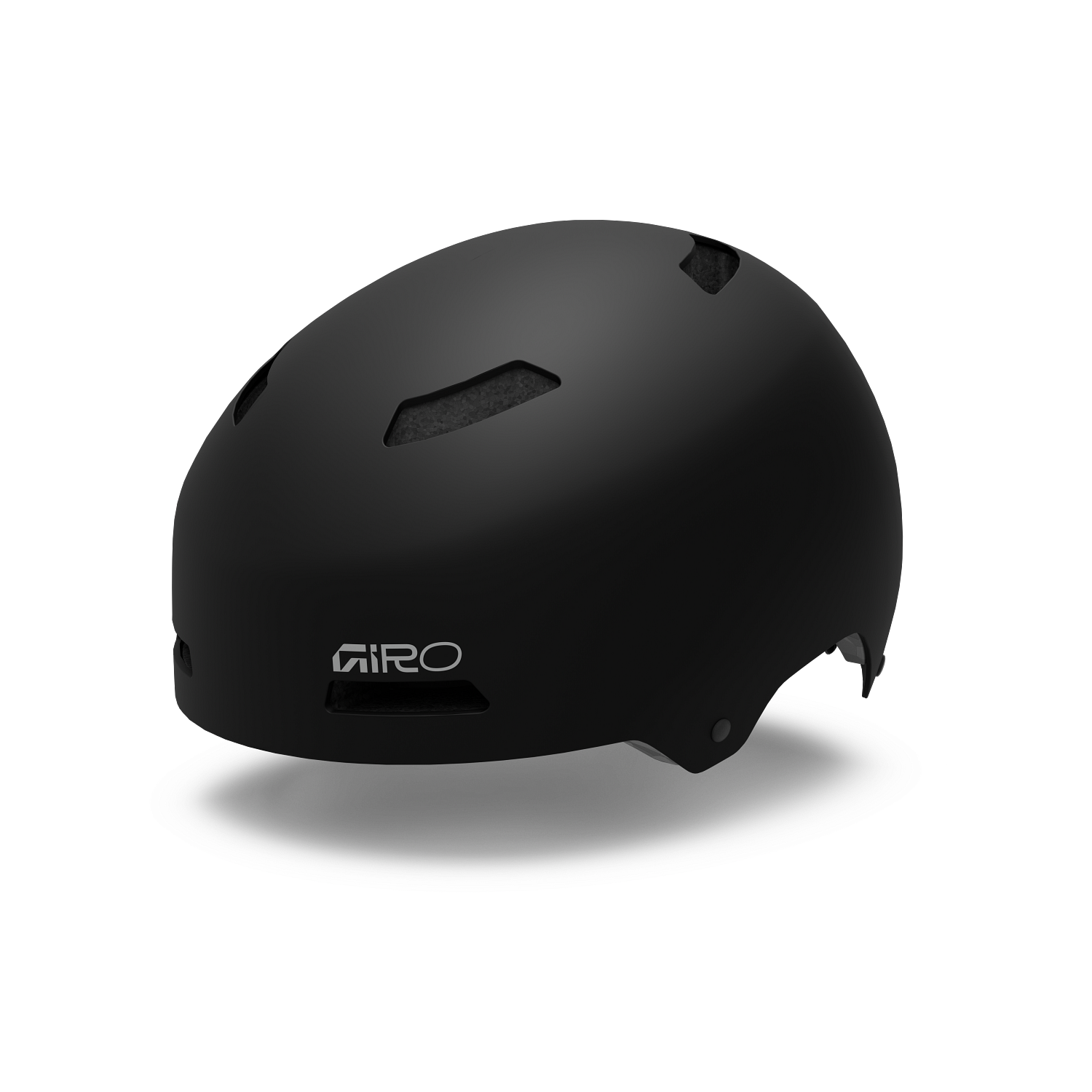
The use description names trails and the skate park, which supports the finder’s trail category. It does not establish full-face coverage, a chinbar, or suitability for every downhill or gravity discipline. The manufacturer image shows a rounded half-shell form, but a product photograph cannot substitute for the exact labeling or instructions. The page does not report a numerical vent count, and I would not infer cooling from the visible openings alone.
Three sizes, but no personal-fit conclusion
The page offers S, M and L. Giro's adult chart maps them to 51–55 cm, 55–59 cm and 59–63 cm. That makes 51–63 cm a practical chart screen for this exact plan; it is not a claim that every head in that range fits the shell. Adjacent size rows meet at their endpoints, so a circumference of 55 or 59 cm does not decide which size to buy. Try the exact model on, follow its instructions, and check that it sits level and stable without interfering with vision.
Giro says the pads are easy to change for dialing in fit, but the exact page does not identify a dial-based retention system or give an adjustment range. Nor does it publish a head-shape profile. Padding changes should not be treated as a way to compensate for an unsuitable shell, and no fit claim here is based on wearing the helmet.
Integrated Mips is not Spherical Technology
The exact feature block names integrated Mips and describes its design goal in certain impacts. That is distinct from Giro's Spherical Technology powered by Mips. The finder consequently treats Quarter Mips as integrated Mips only; the word “Mips” does not satisfy the narrower Spherical/Mips requirement. Neither architecture predicts an individual crash outcome, and this site has not performed impact testing.
The distinction also separates this model from Quarter Helmet style 002, whose exact page does not name Mips, and Quarter Mips SE style 138, whose page names Mips but leaves activity and CPSC wording unstated. These records are not interchangeable simply because their names share “Quarter.” A seller's short title is not enough to identify the style, finish, size or marking.
Standards and the stated Medium weight
Giro states that this exact US style complies with the CPSC bicycle-helmet standard for persons age five and older. It lists 480 g for a Medium CPSC reference. That number is a manufacturer specification rather than an independent weighing, and it is not a weight for each size or a promise about how the helmet feels. Check the physical CPSC marking on the actual unit and confirm the manufacturer's instructions and current notices; a web page cannot verify a seller's item's history, authenticity or condition.
The page gives no vent total, no numerical adjustment range and no independent safety or durability comparison. Those omissions matter if a measured feature or a lighter-feeling helmet is a must-have. For trail shoppers, Quarter Mips has an unusually clear combination of dirt/skate use wording, replaceable pads, Mips and CPSC evidence; its tradeoffs are the high stated Medium figure, a limited S–L chart and the lack of a named dial adjuster. Confirm the exact style, size, label and return terms before choosing an offer. This is a source-based assessment, not hands-on testing.
Key specifications
Key details at a glance
| Helmet style | Half-shell |
|---|---|
| Listed fit sizes | S / M / L |
| Published circumference floor | 51 cm |
| Published circumference ceiling | 63 cm |
| US CPSC compliance stated | Yes |
| Rotational-impact design | Integrated Mips |
| Fit adjustments described | Giro says the plush, sweat-absorbent pads are easy to swap to help dial in fit; the exact page does not identify a dial-based retention system or adjustment range. |
| Manufacturer-stated CPSC Medium weight | 480 g |
Use the exact model’s instructions for operating limits, supplied equipment and version differences.
Sources for this review
Sources for this assessment
Compare the model with your own constraints
A model assessment cannot decide fit by itself. Use the finder to combine riding use, head circumference and documented features, then verify the exact helmet and instructions.