
Your needs, this model
Does it fit your priorities?
Why is Artex Mips matched to trail riding when its profile is road-race inspired?
Giro describes the compact silhouette as road-race inspired, but its US MTB collection lists Artex among mountain-bike helmets. This assessment follows the actual collection classification while keeping the styling description separate from a road-racing performance claim.
Explore this need in the finder →Does Artex Mips document US CPSC compliance?
The exact US page lists CE EN 1078 but does not state CPSC compliance. Its CPSC status remains unknown here; verify the exact helmet label and current manufacturer documentation rather than treating missing page text as proof either way.
Explore this need in the finder →Does Artex Mips use Giro Spherical Technology powered by Mips?
The exact page names an integrated Mips system and Roc Loc 5 Air Mips, but no Spherical designation. It therefore does not meet the narrower Spherical/Mips requirement in the finder.
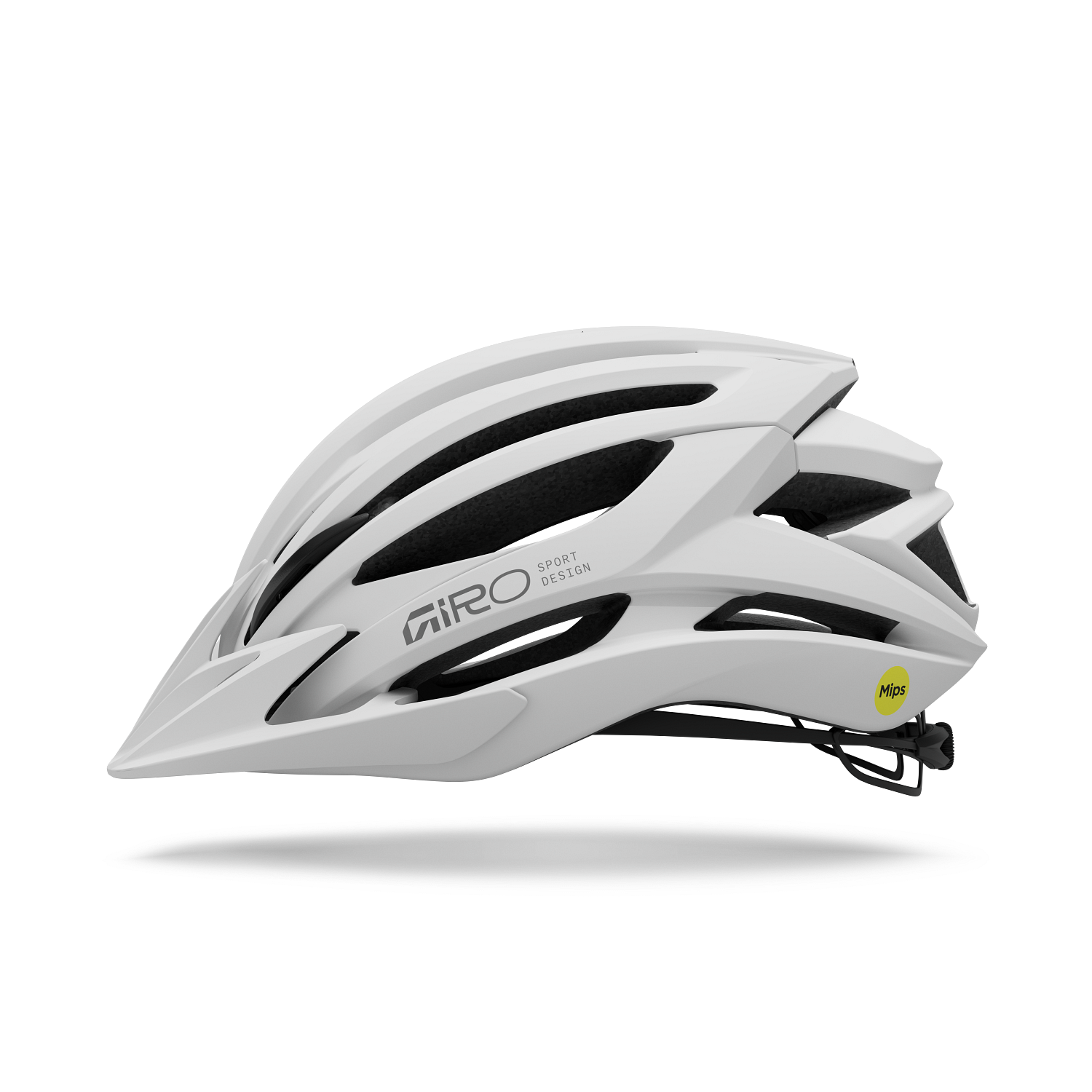
Explore this need in the finder →Artex Mips occupies an unusual corner of Giro’s US MTB collection: the exact product page describes a compact, road-race-inspired profile but pairs it with slightly deeper coverage and a removable visor. The current MTB listing places it among mountain-bike half-shells. This review covers US style 100000000500000076 and the observed Matte White / M configuration, SKU GR-7202140. It is not a claim that the helmet has been ridden, weighed or fit-tested by this guide.
A road-inspired shape in an MTB listing
The exact product copy uses road-race inspiration to describe the compact design, but Giro’s US MTB collection lists Artex with its mountain-bike helmets rather than in the Road collection. The practical interpretation here is therefore a trail half-shell with a compact visual profile, not a proven road-racing helmet. The page also mentions a removable visor and somewhat deeper coverage. Those are useful form-factor distinctions, but they do not prove full-face protection, a specific downhill rating or a helmet’s fit on a particular head.
The shell is described as polycarbonate fused to the EPS liner, with a hard outer shell and in-mold Hardbody lower wrap. Giro calls out its Wind Tunnel ventilation system and internal channeling but gives no numeric vent count on the captured page. “Enhanced cooling” is manufacturer language rather than a measured result. Riders comparing shell openings should not assume that Artex is cooler because of its appearance or its name.
Roc Loc 5 Air Mips and removable visor
Artex’s clearest functional differentiator is Roc Loc 5 Air Mips. Giro describes a design that suspends the helmet slightly off the top of the skull to allow airflow over the head, alongside fit and stability adjustments. The system lets the rider tune tension and fore-aft tilt; it remains a retention system, not a substitute for choosing the right shell size. Try it on and verify that the helmet sits level and stable without pressure points.
The removable visor gives the wearer another configuration choice. It may suit a rider who wants some shade or an open look without leaving a permanently fixed peak, but the page does not establish that removing it changes the helmet’s safety characteristics or guarantees eyewear compatibility. Verify the supplied visor and attachment pieces in the exact offer and follow Giro’s instructions for fitting or removing them.
The certification and weight panel lists CE EN 1078 and 280 g for size M. Weight is a manufacturer-stated figure, not an independent measurement; it is lower on paper than the 300 g Radix Mips and 340 g Source Mips M figures. That limited comparison says nothing about comfort, fit, cooling or impact protection. The product page’s CPSC wording is absent from the captured text, so US CPSC status remains unknown here.
Mips terminology and standards limits
The exact page describes an integrated Mips brain-protection system, with Giro explaining its intended role in reducing rotational forces during certain angled impacts. It does not identify this configuration as Spherical Technology powered by Mips. For that reason, Artex does not satisfy a specific Spherical/Mips requirement in the finder. Mips is a design description, not an individual crash-outcome guarantee.
The page’s CE EN 1078 entry should not be silently changed into a CPSC statement. This review treats the missing US CPSC wording as unknown rather than non-compliant. If CPSC documentation is required, inspect the exact product label and seek current manufacturer evidence before purchase or use; a sibling model or broad Giro page cannot fill this record’s gap.
Sizes, boundaries and individual fit
The product page offers S, M, L and XL. Giro’s general bike chart lists S as 51–55 cm, M as 55–59 cm, L as 59–63 cm and XL as 63–65 cm, giving a combined 51–65 cm screening span. That chart is not a personalized fit result. Measure around the widest point of the head with the tape level, then confirm position, retention and comfort on the exact Artex shell. A similar circumference does not mean two different helmet shapes will feel the same, and no source reviewed here documents an individual head-shape profile.
How Artex differs from other trail options
Against Radix Mips and Source Mips, Artex pairs Roc Loc 5 Air Mips with a removable visor, while Radix names Roc Loc 5 Mips and an indexed P.O.V. visor, and Source names Roc Loc 5 Mips plus a tool-free, bolt-on moto-style visor. Giro publishes 280 g for Artex M, 300 g for Radix M and 340 g for Source M. Source is also the only one in this trio whose page states 17 vents. Artex and Radix have no exact count in their captured product text. These are source-field contrasts, not performance-test findings.
The MTB collection context supports comparing Artex for trail use, despite its road-race-inspired styling. A rider whose priority is a race-specific road model should compare products explicitly listed in Giro’s Road category and check their own construction, fit and standard documentation. Artex’s silhouette alone is not evidence of an aerodynamic test or road-race certification.
Who may want to try it?
Artex deserves a try-on if you want an open-face trail helmet with a removable visor, adjustable Roc Loc 5 Air Mips and a manufacturer-stated 280 g size-M weight. Its compact profile may appeal to someone who prefers less of a bulky MTB look, but personal fit and perceived airflow cannot be predicted from the page. Its evidence gaps are no published vent count, no exact head-shape guidance, no Spherical designation and no captured CPSC statement. Confirm the model, size, finish and package, check the physical compliance markings, and test the fit before use. The assessment is research-based and makes no personal-use or hands-on claim.
Key specifications
Key details at a glance
| Helmet style | Half-shell |
|---|---|
| Listed fit sizes | S / M / L / XL |
| Published circumference floor | 51 cm |
| Published circumference ceiling | 65 cm |
| Rotational-impact design | Integrated Mips |
| Fit adjuster | Roc Loc 5 Air Mips |
| Fit adjustments described | one-hand tension adjustment / fore-aft tilt adjustment |
| Manufacturer-stated Medium weight | 280 g |
Use the exact model’s instructions for operating limits, supplied equipment and version differences.
Sources for this review
Sources for this assessment
Compare the model with your own constraints
A model assessment cannot decide fit by itself. Use the finder to combine riding use, head circumference and documented features, then verify the exact helmet and instructions.